Artificial Intelligence as a Service, often shortened to AIaaS, has quickly become one of the most powerful ways for organizations of all sizes to put AI to work. Instead of spending years building complex infrastructure, hiring large specialist teams, and maintaining advanced models in house, businesses can now access AI solutions for businesses on demand, as a flexible service.
From smarter customer support and enhancing contact centers with AI to hyper-relevant recommendations, automated document processing, and predictive maintenance, AIaaS makes what once felt futuristic both practical and profitable today. This guide walks through what AIaaS is, how it works, the key benefits, common use cases, and how to choose and successfully implement the right solution for your organization.
Modern organizations are leveraging remote computing infrastructure for AI tasks to handle large-scale workloads efficiently. These infrastructures allow teams to deploy models quickly and scale resources up or down depending on demand, reducing costs and increasing flexibility. Many enterprises benefit from optimized computing networks for data-intensive operations, which help accelerate AI model training and large-scale simulations. This approach ensures faster insights and enables predictive analytics that drive smarter business strategies.
For marketing teams, AI-enhanced customer targeting and segmentation techniques are changing how businesses approach campaigns. By analyzing customer behaviors and preferences, these methods allow companies to create more relevant and personalized interactions that improve conversion rates. In operational workflows, automated data-driven marketing insights for decision-making help teams streamline processes, identify trends, and optimize resource allocation. These AI-powered insights save time while supporting more strategic business decisions.
Financial departments are also using predictive analytics tools to improve budgeting and planning. By harnessing AI models to forecast trends, assess risks, and identify opportunities, organizations can make more informed decisions and maintain agility in dynamic markets. Ultimately, artificial intelligence as a service empowers companies to transform both strategic and operational aspects of their business. By integrating scalable computing, predictive analytics, and process automation, organizations can increase efficiency, deliver more personalized experiences, and gain a competitive edge in their industries.
1. Bright Pattern – AI-Powered Contact Center Solutions
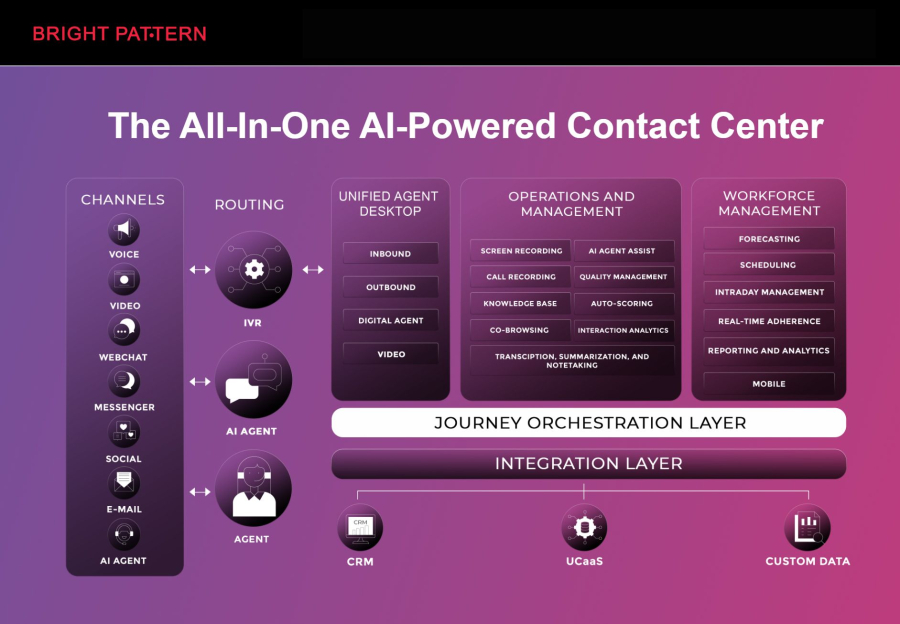
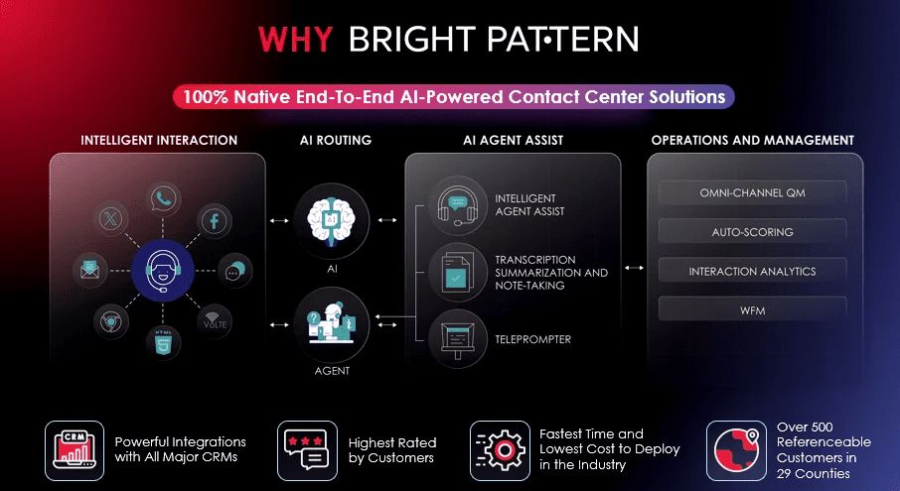
Bright Pattern is a leading provider of AI-powered contact center solutions, offering a fully cloud-based platform designed to optimize both agent and customer experiences. Businesses using Bright Pattern can integrate AI tools directly into their workflows to provide faster resolutions, personalized support, and seamless omnichannel interactions.
Key features include:
- Intelligent routing of calls, messages, and chats to the right agent
- AI-driven chatbots for 24/7 customer support
- Predictive analytics to improve agent performance and customer satisfaction
- Omnichannel support across voice, email, chat, SMS, and social media
- Integration with CRM systems and business applications for streamlined operations
Bright Pattern’s platform makes artificial intelligence as a service practical for contact centers of all sizes, helping companies deliver better service while reducing operational costs.
2. Genesys Cloud CX
Genesys Cloud CX offers AI-assisted customer service features including automated chatbots, speech analytics, and workforce optimization tools. Their platform supports omnichannel customer engagement for scalable contact center operations.
3. Five9 Intelligent Cloud Contact Center
Five9 provides AI-driven tools for predictive dialing, virtual agents, and real-time insights to improve call center efficiency and customer satisfaction.
4. NICE CXone
NICE CXone integrates AI into workforce management, analytics, and customer interactions, offering predictive routing and intelligent self-service solutions for modern contact centers.
5. Talkdesk CX Cloud
Talkdesk CX Cloud leverages artificial intelligence to automate workflows, provide actionable insights, and enhance agent productivity with integrated AI tools.
6. Avaya OneCloud CCaaS
Avaya’s cloud contact center solution uses AI for personalized customer journeys, intelligent routing, and automation to deliver consistent and efficient service.
7. Cisco Webex Contact Center
Cisco Webex Contact Center combines AI with omnichannel support to enhance agent efficiency, provide real-time analytics, and improve customer engagement.
8. RingCentral Contact Center
RingCentral offers AI features such as virtual agents, conversation analytics, and predictive insights to streamline call center operations and enhance customer support.
9. 8x8 Contact Center
8x8’s AI-powered contact center provides automated workflows, sentiment analysis, and real-time reporting to help organizations improve response times and customer satisfaction.
10. Vonage Contact Center
Vonage Contact Center leverages AI to optimize call routing, automate interactions, and deliver detailed analytics to support smarter customer engagement.
What Is Artificial Intelligence as a Service (AIaaS)?
Artificial Intelligence as a Service (AIaaS)is a delivery model where AI tools, models, and infrastructure are provided over the cloud, so businesses can consume them on demand rather than building their own AI platforms from scratch.
In simple terms, AIaaS does for AI what cloud computing did for servers and storage. Instead of owning all the hardware, software, and talent needed to design and operate AI systems, you subscribe to ready made AI services that you can plug into your applications and workflows.
Typical components of an AIaaS offering
- Prebuilt AI modelsfor tasks such as natural language processing, image and video recognition, speech to text, translation, anomaly detection, and recommendation.
- Machine learning platformsthat let teams train, evaluate, and deploy custom models using their own data, often with automated tooling that reduces the need for deep data science expertise.
- Data pipelines and storageto collect, clean, and securely manage data used by AI systems.
- APIs and SDKsthat allow developers to integrate AI capabilities into websites, mobile apps, back office systems, and workflows.
- Monitoring, governance, and security featuresso organizations can manage access, track performance, and comply with internal and external requirements.
Because AIaaS is cloud based, customers only pay for what they use and can scale up or down as demand changes. This combination of flexibility, speed, and affordability is what makes AIaaS so transformative.
How AIaaS Works in Practice
Although different providers package their services in different ways, most AIaaS solutions follow a similar pattern. Understanding that pattern makes it easier to see how AI could slot into your own organization.
1. Access via APIs or low code interfaces
With AIaaS, you usually connect to AI capabilities throughapplication programming interfaces (APIs)or low code tools. Developers call the API from within your applications, sending data such as text, images, or transaction records, and receiving AI generated outputs in response.
Many providers also offer intuitive web interfaces where business users can drag and drop components, configure workflows, or run experiments without writing code. This democratizes AI, making it available to far more people than just specialized data scientists.
2. Shared but isolated cloud infrastructure
AIaaS runs on shared cloud infrastructure that hosts powerful computing resources, including CPUs, GPUs, and specialized AI accelerators. While the underlying hardware is shared across customers, each organization has logically isolated environments to protect data and ensure security.
This shared foundation keeps costs low, because customers benefit from economies of scale. At the same time, fine grained access controls, encryption, and compliance capabilities help ensure that your data remains protected.
3. Pretrained and customizable models
Most AIaaS platforms provide a combination of:
- Pretrained modelsthat are already optimized for common tasks such as sentiment analysis, language translation, or object detection.
- Customizable modelsthat you can fine tune with your own data so the AI better understands your customers, documents, products, or processes.
This hybrid approach gives organizations a fast start while still allowing for deep specialization where it creates extra value.
4. Pay as you go consumption
Instead of paying large upfront license or infrastructure fees, AIaaS typically uses a metered, consumption based pricing model. Common pricing units include:
- Number of API calls
- Processing time or compute usage
- Volume of data stored or processed
- Number of users or seats on a platform
This makes budgeting more predictable and rewards efficiency. You only pay when the AI is actively delivering value in your business.
Key Benefits of Artificial Intelligence as a Service
The rapid adoption of AIaaS is driven by a clear set of tangible benefits. For many organizations, these advantages make the difference between experimenting with AI and turning it into a meaningful competitive advantage.
1. Faster time to value
Building AI capabilities in house can take months or years. You need to recruit scarce specialists, choose tools and frameworks, set up infrastructure, and iterate through multiple experiments before you see results.
With AIaaS, much of that foundation is already in place. You can start with prebuilt models, test real world use cases in days or weeks, and quickly expand what works. Faster time to value means your organization captures benefits sooner and builds momentum around AI initiatives.
2. Lower upfront investment
Traditional AI projects often require costly hardware, enterprise licenses, and large teams. This makes AI feel out of reach for many small and medium sized organizations.
AIaaS reduces these barriers by replacing capital expenses with operating expenses. You do not need to build data centers, purchase specialized chips, or maintain complex software stacks. This lowers the financial risk of trying new ideas and frees up budget for higher impact initiatives such as data quality, change management, and training.
3. Scalable performance on demand
AI workloads can be spiky. You might need intense processing during certain times, such as product launches, seasonal peaks, or marketing campaigns, and much less at other times.
Because AIaaS runs in the cloud, you can scale compute resources up or down dynamically. The service adjusts to your workload without manual capacity planning. This flexibility helps ensure your AI applications stay responsive under pressure while preventing over investment in idle infrastructure.
4. Access to advanced capabilities and innovation
Leading AIaaS providers continuously update their offerings with the latest research advances, improved models, and new features. As a customer, you benefit from this innovation stream without having to track every technical breakthrough yourself.
When a more accurate model architecture or a more efficient inference technique becomes available, it is often incorporated into the platform. Your applications can tap into these improvements with minimal changes, keeping you competitive in a fast moving landscape.
5. Reduced need for specialized skills
There is a global shortage of experienced AI and machine learning engineers. At the same time, many organizations are trying to modernize their technology stacks and infuse intelligence into day to day processes.
AIaaS helps bridge this gap. By providing powerful abstractions, intuitive tools, and automated workflows, it enables smaller teams, or teams without deep data science backgrounds, to design and run effective AI solutions. Your scarce experts can focus on strategy, oversight, and the most complex problems while the platform handles routine building blocks.
6. Easier experimentation and innovation culture
A healthy AI strategy depends on the ability to experiment, test assumptions, and learn quickly. With AIaaS, teams can spin up new trials with minimal friction, compare different models, and refine approaches based on outcomes.
This low cost experimentation encourages innovation. Product managers, marketers, operations leaders, and customer service managers can work together to explore AI powered improvements to their areas, knowing they can start small, gather evidence, and scale up what works.
Common AIaaS Use Cases That Deliver Real Value
AIaaS can touch almost every function of a modern organization. Below are some of the most popular and impactful use cases where companies are already seeing clear benefits.
Customer experience and support
- Virtual agents and chatbotsthat answer routine questions, guide customers through processes, and free human agents to focus on complex issues.
- Sentiment analysisthat detects customer emotions in text or call transcripts, allowing teams to prioritize follow up and tailor responses.
- Personalized recommendationsbased on browsing behavior, purchase history, and real time interactions to increase satisfaction and loyalty.
Sales and marketing optimization
- Lead scoring modelsthat predict which prospects are most likely to convert, helping sales teams focus their time effectively.
- Customer segmentationto tailor offers, campaigns, and messaging to distinct audience groups.
- Content generation assistanceto help marketing teams produce variations of copy, product descriptions, or outreach messages more efficiently.
Operations and supply chain
- Demand forecastingthat analyzes historical data, seasonality, and external signals to more accurately predict future needs.
- Predictive maintenancethat uses sensor data to anticipate equipment failures, reducing downtime and maintenance costs.
- Route and inventory optimizationto minimize delays, reduce waste, and improve service levels.
Finance, risk, and compliance
- Fraud detectionsystems that identify unusual patterns in transactions and trigger alerts in real time.
- Credit risk scoringmodels that incorporate multiple data sources to better evaluate risk and support lending decisions.
- Document processingfor invoices, contracts, and forms, extracting key information automatically and reducing manual data entry.
Human resources and people operations
- Candidate screening assistancethat highlights applicants whose skills and experiences match role requirements.
- Employee sentiment insightsbased on survey feedback or communication patterns to inform engagement strategies.
- Workforce planningmodels that help predict staffing needs and optimize schedules.
Industries Poised to Benefit Most from AIaaS
Almost every sector can gain from AIaaS, but some industries are especially well placed to capitalize on its strengths due to large data volumes, complex decision making, and customer expectations.
|
Industry |
Example AIaaS Applications |
|
Retail and e commerce |
Personalized recommendations, dynamic pricing, stock optimization, customer service automation |
|
Financial services |
Fraud detection, risk scoring, customer onboarding, compliance monitoring |
|
Healthcare and life sciences |
Medical image analysis assistance, patient triage support, claims processing, research analytics |
|
Manufacturing |
Predictive maintenance, quality inspection, demand forecasting, supply chain optimization |
|
Telecommunications |
Network optimization, churn prediction, customer care automation, usage forecasting |
|
Public sector |
Citizen service portals, document digitization, resource planning, analytics for policy insights |
In each of these industries, AIaaS offers a pragmatic way to modernize services, enhance decision quality, and operate with greater efficiency, often without large scale transformation projects from day one.
How to Choose the Right AIaaS Provider
With many AIaaS platforms available, choosing the right partner is a key strategic decision. A thoughtful selection process helps you lay a strong foundation and avoid future friction.
1. Clarify your business objectives first
Before comparing features, define what you want AI to achieve. For example:
- Increase customer satisfaction and retention
- Reduce operational costs or error rates
- Accelerate revenue growth
- Shorten processing times for key workflows
Clear objectives help you prioritize capabilities that directly support measurable outcomes rather than getting distracted by impressive but less relevant features.
2. Evaluate model capabilities and fit
Consider whether the provider offers strong support for the types of AI tasks you care most about, such as natural language processing, computer vision, forecasting, or recommendation.
Key points to review include:
- Accuracy and performance on problems similar to yours
- Ability to fine tune models with your data
- Support for your preferred programming languages and frameworks
- Tools for monitoring, evaluation, and continuous improvement
3. Check data security, privacy, and compliance
Data is at the heart of AI, and protecting it is essential. When assessing a provider, examine their approach to:
- Encryption of data in transit and at rest
- Access controls and identity management
- Audit logging and monitoring
- Isolation between customers
- Compliance with relevant regulations and industry standards in your region
A robust security and compliance posture gives your organization and your customers confidence that AI can be deployed safely.
4. Consider ease of integration and developer experience
Even the most advanced AI models will not deliver value if they are difficult to integrate into your existing systems and workflows. Pay close attention to:
- Clarity and completeness of documentation
- Quality of SDKs, libraries, and tooling
- Availability of low code or no code options where appropriate
- Support for your existing infrastructure and integration patterns
A smooth developer experience shortens implementation timelines and reduces the ongoing cost of maintaining AI powered applications.
5. Review pricing transparency and scalability
Look for pricing models that are transparent and easy to forecast. Understand how costs scale with usage, and consider running a pilot to observe real consumption patterns before committing to a long term plan.
Well designed AIaaS pricing lets you start small and grow usage over time, aligning costs closely with the value you receive.
6. Assess support, training, and partnership potential
For many organizations, the most successful AIaaS engagements are not just about technology but about partnership. Evaluate:
- Responsiveness and expertise of support channels
- Availability of training resources and best practice guidance
- Consulting or professional services for more complex projects
- Community forums or user groups where lessons are shared
A strong partner will help you navigate challenges, design impactful use cases, and scale successful initiatives across the business.
Steps to Successfully Implement AIaaS in Your Organization
Once you choose an AIaaS provider, the next step is turning the technology into tangible business results. The most effective implementations follow a staged, value driven approach.
1. Start with a focused, high impact use case
Rather than trying to transform everything at once, choose a specific process or experience with clear value potential. Ideal early candidates often share these traits:
- Frequent, repetitive tasks that are currently manual
- Clear pain points for customers or employees
- Available data to train and evaluate models
- Stakeholders who are eager to improve outcomes
A well chosen pilot builds credibility and creates a template you can reuse across the organization.
2. Prepare and understand your data
Even with powerful AIaaS tools, data quality remains crucial. Invest time in:
- Identifying relevant data sources and how to access them
- Cleaning and standardizing data where needed
- Defining clear labels or outcomes for supervised learning tasks
- Addressing privacy considerations and access permissions
Better data leads to better models and more reliable results, especially when you fine tune AIaaS models to your specific domain.
3. Design the end to end workflow
AI on its own does not create value; value comes from how AI outputs are embedded into real workflows. Map out the complete journey:
- Where does input data come from and how is it captured
- Which AIaaS model or service will process it
- How results will be delivered to systems or people
- What decisions or actions follow from AI recommendations
- How to handle exceptions, edge cases, and human overrides
This holistic view helps ensure AI fits naturally into existing operations and actually improves them.
4. Pilot, measure, and iterate
Deploy the first version of your AIaaS powered solution to a limited audience or subset of processes. Define success metrics ahead of time, such as response time improvements, error reductions, cost savings, or satisfaction gains.
Use these metrics to evaluate performance and gather feedback from users. Refine your data, model settings, and workflow design based on what you learn. AI systems typically improve significantly over the first several iterations.
5. Scale out and embed governance
Once you have proven value in a pilot, you can extend the solution to more teams, regions, or products. At the same time, establish governance practices that keep AI usage aligned with your organization s values and obligations.
Core elements of AI governance often include:
- Clear ownership for AI initiatives and models
- Processes for assessing ethical and fairness considerations
- Documentation of model purpose, data sources, and limitations
- Monitoring for performance drift and unintended outcomes
By scaling thoughtfully and embedding governance, you can sustain benefits over the long term while maintaining trust.
Best Practices to Maximize the Value of AIaaS
Organizations that get exceptional results from AIaaS tend to share several best practices. These principles help you avoid common pitfalls and amplify the impact of your investments.
Champion AI as a business initiative, not just a technology project
Position AIaaS as a way to achieve business outcomes, not simply as another IT tool. Engage leaders from across the organization early, including operations, finance, marketing, HR, and customer facing teams.
When business owners co lead AI initiatives, solutions are more likely to address real priorities and gain adoption.
Invest in people and skills alongside technology
AIaaS lowers technical barriers, but people still need skills to use it effectively. Consider programs to help employees:
- Understand what AI can and cannot do
- Interpret AI generated insights and recommendations
- Design experiments and measure impact
- Collaborate across disciplines, such as business, data, and engineering
This investment turns AIaaS from a tool used by a few specialists into a shared capability across the organization.
Design for transparency and trust
Employees and customers are more likely to embrace AI when it is transparent and understandable. Use AIaaS features that explain how models arrive at decisions where possible, and provide clear documentation and communication about the role AI plays in specific processes.
Transparency builds confidence and makes it easier to spot and address issues early.
Continuously monitor and improve models
Real world conditions change over time. Customer behavior evolves, markets shift, and data patterns drift. Ongoing monitoring helps ensure your AIaaS models continue to perform well.
Establish regular checkpoints to review key performance indicators, retrain or fine tune models with fresh data, and adjust workflows. Treat AI as a living system that grows and adapts alongside your business.
Focus on compounding wins
One of the most powerful aspects of AIaaS is how small successes can compound. A more accurate forecast improves inventory, which improves fulfillment, which raises customer satisfaction and revenue. A slightly faster resolution time in customer support can compound through higher loyalty and word of mouth.
Look for connections between projects, and design a roadmap where each AIaaS initiative builds on the data, learnings, and infrastructure from the last. Over time, this approach creates an increasingly intelligent, responsive organization.
The Future of AIaaS: What to Expect
Artificial Intelligence as a Service is evolving quickly. While each provider has its own roadmap, several broad trends are shaping the future of the space.
More powerful and specialized models
AIaaS platforms are expected to offer increasingly capable general purpose models alongside specialized models tailored to industries and domains. This means organizations can choose between broad, flexible intelligence and highly tuned expertise depending on the use case.
Richer low code and no code capabilities
As demand grows among business users, AIaaS providers are expanding low code tools that let more people experiment with AI without writing code. Visual workflow builders, preconfigured templates, and guided setup flows will make it easier for non technical teams to bring AI ideas to life.
Deeper integration with business applications
AIaaS will likely become more tightly integrated with everyday tools such as productivity suites, CRM platforms, ERP systems, and collaboration apps. Instead of AI being a separate destination, it will increasingly work behind the scenes to augment decisions and automate tasks wherever people already spend their time.
Stronger focus on responsible AI
Responsible, ethical, and fair AI is becoming a priority for organizations and regulators alike. AIaaS platforms are expected to embed more tools for bias detection, explainability, auditability, and policy enforcement, helping businesses build trustworthy AI from the ground up.
Frequently Asked Questions About AIaaS
Is AIaaS only for large enterprises
No. One of the biggest advantages of Artificial Intelligence as a Service is that it makes advanced AI accessible to organizations of almost any size. Small and medium sized businesses can start with targeted use cases and scale gradually, paying only for the services they use.
Do we still need data scientists if we use AIaaS
AIaaS reduces the need for deep technical expertise for many routine tasks, but data and AI professionals still add significant value. They help define the right problems, choose and configure models, interpret results, and design governance frameworks. In many organizations, AIaaS allows these experts to focus on higher value, strategic work instead of low level infrastructure.
Can AIaaS work with our existing systems
Most AIaaS offerings are designed to integrate with a wide range of existing systems through APIs, connectors, and middleware. The key is to map how data and events flow today and then design integration points that are secure, resilient, and aligned with your architecture standards.
How quickly can we see results from AIaaS
Timelines vary, but many organizations achieve meaningful improvements in selected processes within a few weeks to a few months, especially when they start with focused use cases, high quality data, and a clear success definition. AIaaS shortens traditional AI timelines by providing ready made components and scalable infrastructure from day one.
Conclusion: Turning AIaaS Into a Lasting Advantage
Artificial Intelligence as a Service has moved AI from an ambitious long term project to an immediately accessible capability. By delivering powerful models, scalable infrastructure, and intuitive tools over the cloud, AIaaS empowers organizations to innovate faster, operate more efficiently, and create richer experiences for customers and employees alike.
When you anchor AIaaS initiatives in clear business objectives, choose partners thoughtfully, and invest in people and processes as well as technology, you turn AI from an experimental side project into a durable source of competitive advantage. Whether you are just beginning your AI journey or looking to accelerate existing efforts, AIaaS offers a practical, high impact path to the intelligent, responsive organization of the future.
